
What Braindance Actually Is
Almost every AR and VR porn site sells you video. A camera sat in one place, recorded 180 degrees, and that is where you sit too. Turn your head and the picture follows. Lean forward and nothing happens, because there is nothing behind the image to move.
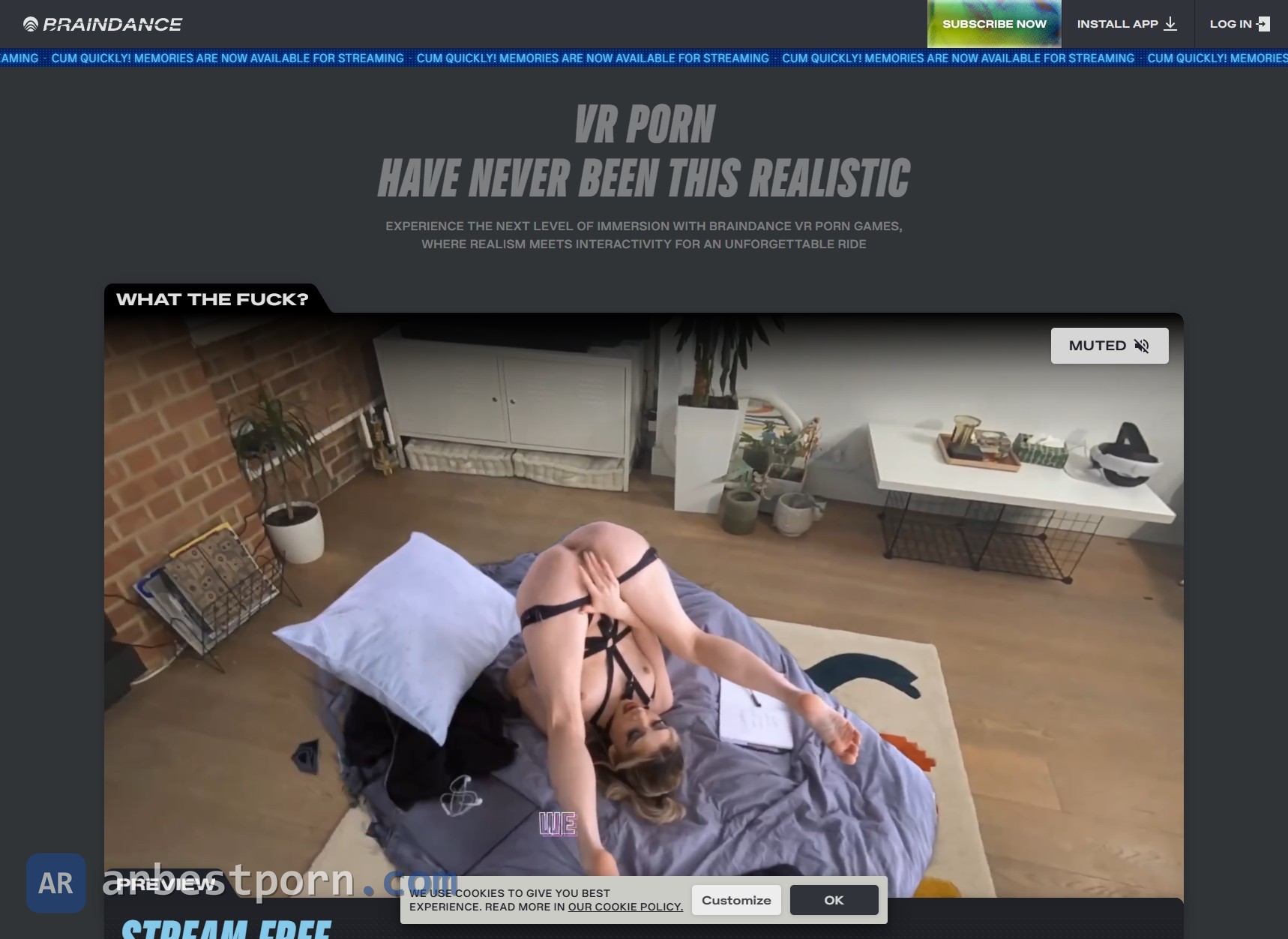
Braindance sells something different. The performer is recorded by 165 cameras at once and rebuilt as a 3D object using Gaussian splatting, a technique for turning a pile of photographs into a scene with actual depth. She has volume. Step to the side and you see her from the side. Crouch and the angle changes. Switch on passthrough and she is standing on your bedroom floor, with your walls behind her.
The company calls each release a "memory card", which is branding, but the underlying idea is straightforward: this is six degrees of freedom, and the rest of the field is three. That single difference is where every strength and every limit below comes from.
Braindance VR vs the Cyberpunk 2077 Braindance
Half the people who search "braindance vr" are not looking for a porn site. They are looking for the thing from Cyberpunk 2077, where a braindance is a recorded memory you replay through a wreath and scrub through layer by layer. That is why a CD Projekt forum thread and two YouTube videos about Night City sit in the same search results as this review.
They are unrelated. Braindance VR is Depthfield Labs Ltd, registered at 86-90 Paul Street in London, and it borrowed the word because the word fits what it sells. There is no wreath, no memory scrubbing, no editor timeline. If you came here for the mission where you scan for thermal clues, you are in the wrong place and nothing below will help.
Volumetric Capture vs 180° VR Video
The comparison that matters is not Braindance against another porn site. It is volumetric capture against the flat stereo video that every other AR and VR site uses.
| What you do in the headset | 180° VR video (most sites) | Braindance memory card |
|---|---|---|
| Turn your head | Works | Works |
| Lean in or back | Nothing moves | Perspective shifts with you |
| Step to one side | Nothing moves | You see her from that side |
| Crouch or stand up | Nothing moves | Angle changes with your height |
| Reach out | Controllers only | Hand tracking is supported |
| What is stored in the file | Flat stereo video | 3D point data, frame by frame |
| Room you are in | Replaced or ignored | Kept, via passthrough |
This is why the file sizes below look absurd next to a normal scene, and why the catalog is small. Nobody has figured out how to make volumetric capture cheap yet.
Passthrough is the other route to putting a performer in your room, and it works differently. Our passthrough AR explainer covers how the video approach compares.
Which Headsets Run Braindance
This is the part the old version of this review got wrong, so here it is checked against the site's own support pages on 9 September 2026. Braindance is not a browser experience. There is a real app, and which device you own decides how good the picture gets.
| Device | How it runs | Quality ceiling | What to know |
|---|---|---|---|
| Meta Quest 3 / 3S | Native standalone app | 4K | The setup Braindance itself recommends. No PC needed. |
| Pico 4 Ultra | Native standalone app | 4K | Same app, same install route. |
| Quest 2, Valve Index, Vive Pro 2 | PCVR, tethered or streamed | Up to 8K, GPU dependent | Needs an RTX 2060 or better on the PC. |
| Apple Vision Pro | Web streaming only | Stream quality | No native app. Works, but you are not getting the download tier. |
| Phone or desktop screen | Flat 2D playback | Flat | The volume is gone. At this point it is ordinary video. |
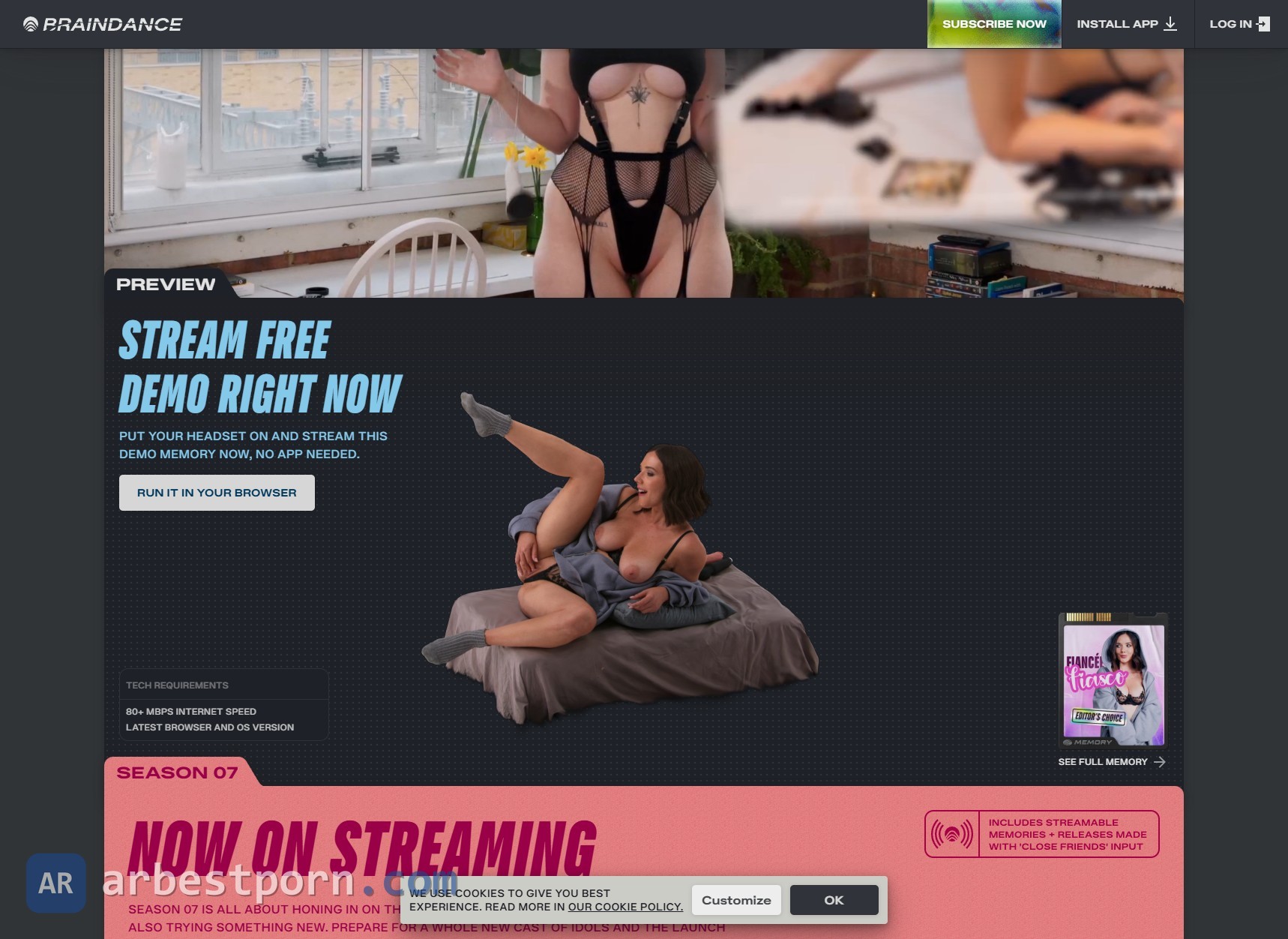
The free demo card is the exception to all of this. It streams straight in the headset browser, no install and no signup, and Braindance asks for 80 Mbps and a current browser version. That is the cheapest possible way to find out whether volumetric capture does anything for you.
What a Memory Card Contains
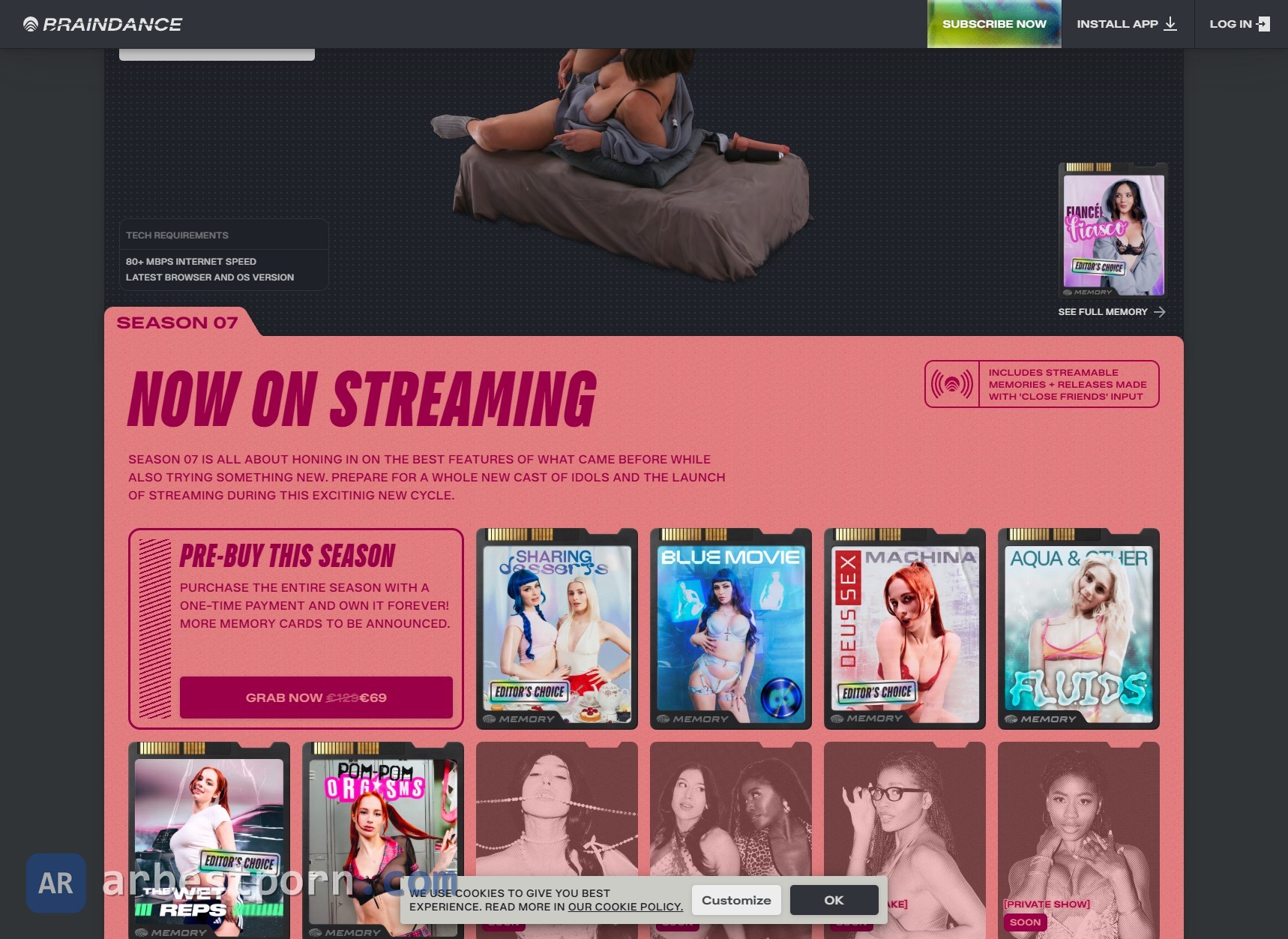
A card is not one long scene. Each one packs 10 to 20 spatial scenes with its own voiceover, and Braindance ships them in seasons. Season 07 was the current block on 9 September 2026, and a season can also be bought outright as a one-time pre-buy rather than through the subscription.
The catalog on that date held 86 cards, 82 of them made by the Braindance studio itself, with 43 performers across them. Most people appear on two or three cards. The names are mainstream rather than unknowns: Melody Marks, Jewelz Blu, Amirah Adara, Vanna Bardot. Tags run to about forty, from the ordinary (lesbian, petite, MILF) to the ones you only get when a studio builds sets on purpose: retro-futurism, mermaid, kimono, food play.
Downloads reach 20 GB per release, and some releases are download-only with no streaming version at all. Sitting alongside the cards are two things Braindance did not shoot: a library of 287 licensed classic VR films, flat 180° footage and a lot of it Naughty America, streaming only; and a live cam section fed from an outside cam network.
The Limits Nobody Puts on the Homepage
Braindance is doing something no other site in this space is doing, and the marketing has run slightly ahead of the product. Four things are worth having straight before you pay.
- 4K and 8K are both true, in different places. The homepage headline says 4K and 8K. Braindance's own FAQ says memory cards are 4K today, and the 8K number is the PCVR ceiling with a strong GPU behind it. Buy a Quest 3 because they recommend it and 4K is the number that applies to you.
- The catalog is 86 cards. The 373 in the pricing page headline counts the licensed classic VR library inside the same number as the volumetric releases. Those are two different products sharing one subscription.
- Storage is a real constraint. At up to 20 GB a release, a 128 GB Quest 3 holds five or six cards before you start deleting things. Plan for streaming or plan for housekeeping.
- There is no trial. One free demo card, then the full plan. Compared with the one dollar day pass at RealVR, that is a colder start, though the free card is a whole card rather than a two-minute teaser.
One more thing to read carefully: every plan on the pricing page is struck through against a much higher list number, $40 for monthly and $599 for lifetime. Whether those prices were ever charged is not something you can verify from outside. What you actually pay is the lower number.
What It Costs
The annual plan is the outlier here. At $69.99 for the year it works out to $5.83 a month, under a third of the monthly rate, and well under the annual plans at AR Porn ($80.04) and POVR ($99.95). If you want to try the format properly for a stretch, that is the plan to take.
Lifetime at $149 breaks even against monthly billing in seven and a half months. Against the annual plan it takes just over two years, which is a long time to bet on a studio that started shipping in 2024. The middle option exists for a reason.
Prices checked on the Braindance subscription page on 9 September 2026 from a US connection. If you see euros instead of dollars, you are being priced by geography and the numbers will not match.
Working out which headset to buy first? Our AR device guide compares what each one can actually run.
Braindance vs the Passthrough AR Sites
Everything else we cover on this site works by passthrough video. The headset's cameras show you your room, and a performer filmed against a plain backdrop is composited into it. It works, it looks convincing, and it is far cheaper to produce. But the camera that filmed her still sat in one spot, so she is a cut-out standing at a fixed distance from you.
Braindance rebuilds her instead. Both approaches put a woman in your bedroom. Only one of them lets you walk around her.
What that costs Braindance is scale. A passthrough studio like the one behind AR Porn can shoot, edit and publish on something close to a normal production schedule. Braindance needs a 165-camera rig and a processing pipeline, and it shows in the catalog size. Whether you want the bigger library or the better trick is the whole decision, and it does not have a general answer.
If you have never tried either, the honest sequence is: stream the free Braindance demo card first, because it costs nothing and it is the clearest possible demonstration of what six degrees of freedom feels like. Then decide whether you want that or you want volume. Our AR versus VR breakdown covers the wider version of the same question.
Score Breakdown
Score breakdown, by our six criteria
Site Information
| Brand | Braindance VR |
| URL | braindancevr.com |
| Operator | Depthfield Labs Ltd, London |
| Capture method | Volumetric, 165 cameras, Gaussian splatting (3DGS) |
| Degrees of freedom | 6DoF (positional), with passthrough and hand tracking |
| Memory cards in catalog | 86 (82 from the Braindance studio) |
| Scenes per card | 10 to 20, each with its own voiceover |
| Performers listed | 43 |
| Bundled classic VR video | 287 licensed flat 180° films, streaming only |
| Native app | Meta Quest 3 / 3S, Pico 4 Ultra |
| PCVR requirement | Nvidia RTX 2060 equivalent or better |
| Max resolution | 4K on the cards, up to 8K in PCVR mode |
| Download size | Up to 20 GB per release |
| Free access | One full demo card, browser streaming, no account |
| Affiliate program | Braindance VR (FirstPromoter) |
Every figure in this table was read off braindancevr.com on 9 September 2026: the catalog page, the cast page, the subscription page and the site's own support FAQ. We have not parsed the catalog scene by scene, so the per-card scene counts come from Braindance itself.
Frequently Asked Questions
Verdict
Braindance is the only site in this space where the technology, not the content, is the reason to sign up. Volumetric capture at 165 cameras is expensive and slow, and you can see both facts in the catalog: 86 cards after two years, against libraries of hundreds elsewhere. The bundled classic VR library is padding, and the marketing rounds 4K up to 8K when it suits.
What survives all of that is the thing itself. Nobody else lets you walk around the performer. If you own a Quest 3 or a Pico 4 Ultra, the demo card costs nothing and answers the only question that matters, which is whether positional freedom is worth the smaller library to you. If it is, the $69.99 annual plan is the sane way in.
If it is not, you want volume and a bigger cast, and our full AR site comparison puts the alternatives side by side.